The Institute’s Educational & Scientific Trust (EST) funded one Student member to attend the Centenary National Study Tour in October at Windsor Great Park. The selected student was Alice Haylock who currently works for the Forestry Commission (FC) as a Development Woodland Officer, and is in her second year of the degree-level Professional Forester Apprenticeship programme. Alice has produced a write-up of the Study Tour below.
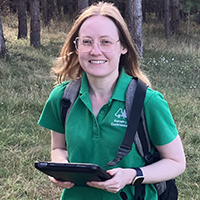
Some time in mid-September, having recently completed the Forest Policy module of my university apprenticeship, I received an email from the Institute to inform me that I’d won the Student Ticket Ballot for their Centenary National Study Tour.
A scam, surely? I never win anything.
But the email address checked out; a few months earlier I had, on a whim, entered a ballot for an important-sounding event touting free food and accommodation for the winner.
Threatened with the impending deadline for the Policy module; apprehensive about my innate dislike of (and incompetence at) networking; dealing with the guilt of winning a ticket that could have benefited a ‘real’ student (rather than a mid-life career changer), I went against my better judgement and accepted.
Sitting down with my overbrimming teacup on the morning of the first day, I had to do a double-take at the programme – Dr Gary Kerr FICFor, a frequent name in my assignment reference lists, was giving the welcome speech! After a few words from him, the event started fully with Richard Everrett introducing the Crown Estate; its land holdings, visitor footfall and conservation goals. Touring Windsor Great Park was an absolute pleasure on a sunny autumn day. The legendary Ted Green MBE introduced us to the formative, awe-inspiring ancient oaks of his childhood, including the 1,300+ year-old King Offa’s Oak. Woodland Officers, Agents, Estate Foresters; we all have these childhood trees which led us into forestry, and every time the speakers invited questions and discussion from the audience it was fascinating to hear perspectives from across the spectrum of professions.
Between the talks, and during the dinner at Browns, I had the opportunity to speak to many different people across the sector, from fellow FC colleagues to private land agents to Dr Kerr himself(!). I received a lot of encouragement and interest in my future career plans, and it became clear how many people began successful forestry careers as Woodland Officers with the FC.
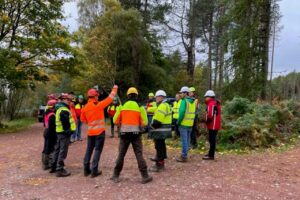
On the second day, I packed up my van expecting a tour through rows of lollipop trees typical of productive forestry. Not the case! Jack Coombes took us to a clearfell site which was in the process of being restored to wetland, for biodiversity and for flood defense. Most of the site had not yet been ecologically populated, allowing the estate to profit from film companies using the site as a WW1 set – the most unique non-timber product I have come across yet. Issues of public access and dogs were raised, which will inform my next university assignment (People and Forests).
The final talk, given by Chris Reynolds, was of particular interest to me: the silvicultural features and growing success of lesser-known productive conifer species. Species choice for resilience, informed by soil and climate conditions, will define future UK forestry and I hope will be a major theme of my future career. Chris was kind enough to send me some follow up reading material and further Forest Research studies after the event.
Despite my initial reservations, the Institute’s Centenary National Study Tour at Windsor was a very enjoyable and valuable two days. I made connections with experienced foresters who were generous with their knowledge and time, which will not only benefit my academic studies but will inform the next steps in my career.
I am grateful to the EST grant, without which attendance would not have been possible for me. I recommend that all student foresters (even old, introverted ones like me!) put their names down for future ballots. It really is a fantastic opportunity.