Emyr Parker is one of two candidates selected for the Young Professional Foresters’ Exchange Programme (2024-2025) and is spending three months in New Zealand working for Juken NZ. Emyr has shared a halfway update on his experience on the exchange programme.

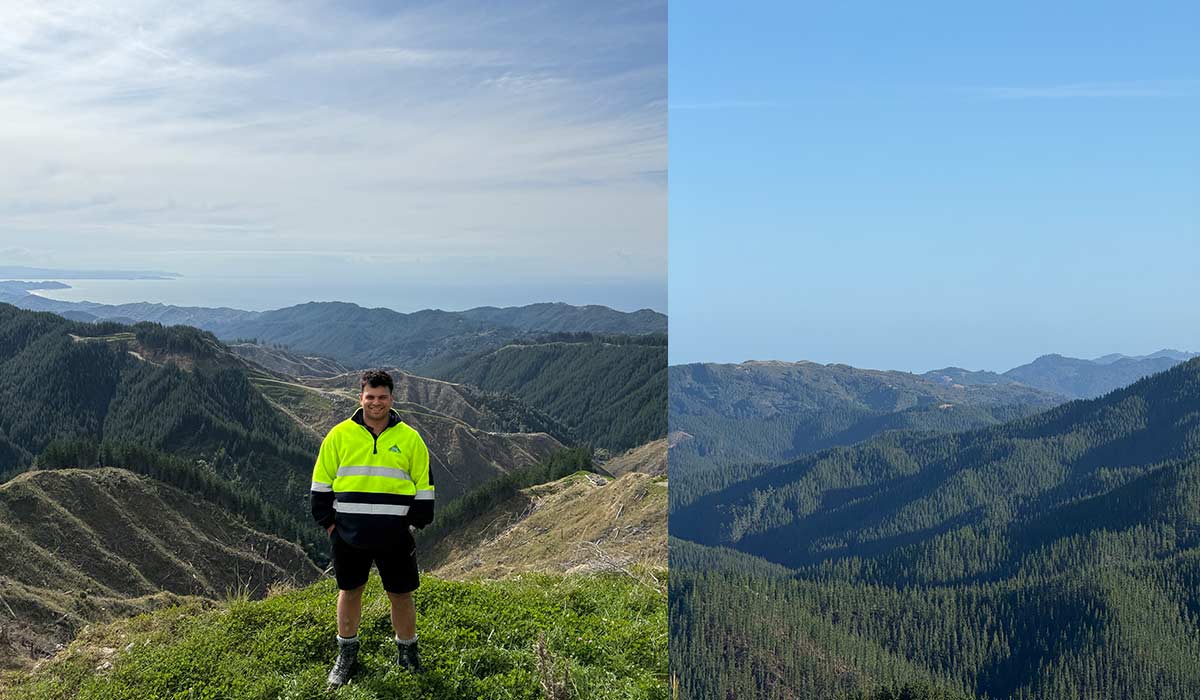
Having spent the first half of my exchange at Masterton, I had the opportunity at the start of April to travel up to Gisborne where Juken have a second base. This allowed me not only to see another, very different, part of New Zealand, but also to experience a completely different forestry environment.
I made my way up the east coast to Gisborne, through beautiful scenery and began to get to grips with interesting challenges at the new location. The East Coast Forest staff are incredibly upbeat, welcoming and ‘cruisy’ considering the harsh conditions they are working in.
They are faced not just with difficult terrain but also have to put up with the moving of goalposts that Gisborne District Council have set for environmental remediations and compliance. I got to know all the JNL staff in Gisborne. My favourite staff member, though, was also their newest – Oreo who is pictured below.

With a ‘Sustainable Harvest Volume’ of 400,000 tonnes per annum in the JNL East Coast Forestry estate, (compared to 208,000 tonnes in the Wairarapa) the operations are on a scale I have not witnessed before.
What surprised me most is the amount of new roading that is being carried out along unstable ridgelines and difficult terrain. Due to the weak, young soils and poor quality of ‘metal’ on site, Juken are having to import all their aggregate to the forest. Several ‘problem child’ forests at elevations of around 600m are full of landslips, dropouts and mobile soils, thus creating enormous challenges for the managers regarding water control. It felt as though the land was fighting back, not wanting to be forestry, and resisting the harsh impact of production.
Forest blocks in New Zealand generally seem to be in large-scale rotations; working each forest, roading where required, stripping the land of pine, restocking, moving on to the next block, and returning in 30 years (not to mention the attendant pruning and thinning operations). I had an opportunity to visit a property managed by Aratu (a neighboring forest management company) which has single blocks of up to 9,000 hectares! It seems that all the East Coast forests are managed similarly and are subject to the same issues. They appear to be losing soils every rotation – especially at the higher elevations. There is, consequently, real concern about how many rotations some of these forests have left.
The impact of Cyclone Gabrielle was catastrophic in the north east of New Zealand in particular. There are still ongoing projects two years on from the event to remove debris from beaches, erect slash traps in rivers or gorges and to carry out serious road repairs. As well as the detrimental effect on lives here, the cyclone also damaged the reputation of forestry; much of the debris that caused such an impact was leftover deadwood from forestry operations. Laying the blame for the damage on forestry was not entirely fair; there were a number of other contributing factors including copious amounts of rainfall in a short space of time and additional debris of Poplar trees, native vegetation and sediment flow from farmlands.
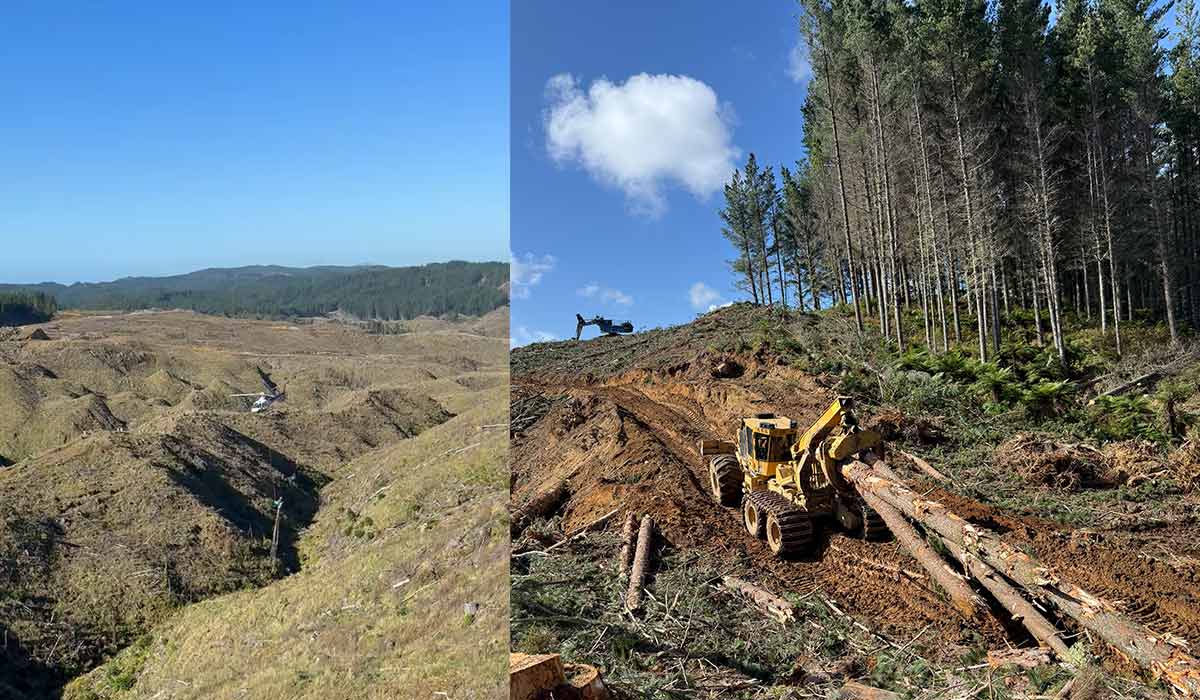
It is a really interesting time to be involved up here as the JNL East Coast mill, although similar to the set up in Masterton, has recently been sold to the Millari Group Australia company who will be setting up operations over the coming months. There are also ongoing large-scale projects to amend skid sites and remove debris considered by Gisborne District Council (GDC) to be a potential risk with the council having issued a plethora of directives and abatement notices to many forestry companies. Some of these ops are unbelievably expensive, with little or no financial gain, nor, in my opinion, any tangible benefit to the environment. One operation included a tethered Tigercat mulcher to mulch slash and offcuts which, according to GDC ‘poses a potential risk of mobilisation and could not be recovered by any other means. There was also debris clearance from guts and ephemeral streams by helicopter.
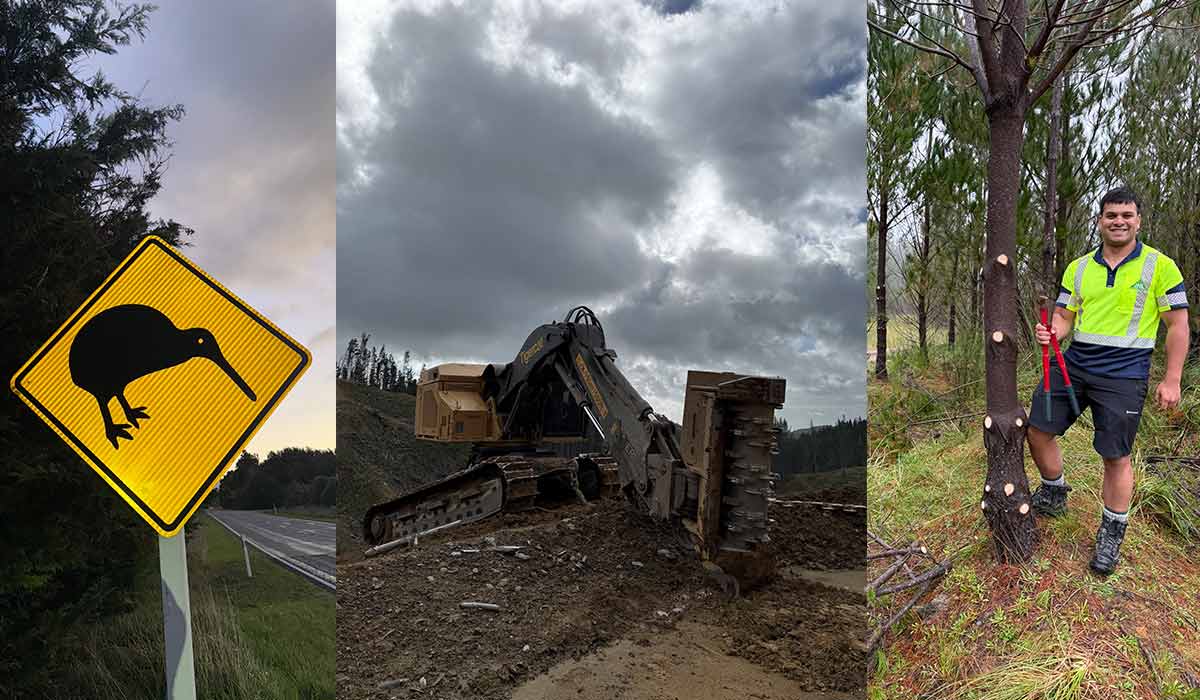
Although I disagree with the council’s dogmatic approach, I do believe a closer look at how harvesting operations are carried out is important. Perhaps there could be a reduction in scale. A market for ‘binwood’ might be found, or increased rules on adjacency might soften the blow. At home, the chip market is so strong, it would be criminal to leave such valuable timber on site to rot, burn, or mobilise. Maybe I’ll sneak some slash home in my suitcase – I’m sure the Kiwis won’t mind.
While having to undertake these operations is not ideal, they were deemed necessary to mitigate environmental risk in a very fragile landscape, and very cool experiences for an interested Welshman! Foresters here are used to frequent helicopter rides during operations and I was grateful to be given opportunities to go up and have a look.
Helicopters seem far more common in forestry in New Zealand, being used for over sowing grass seed, chemical weed spraying, debris removal and even helilogging in some places. Oversowing and hydroseeding was a new concept for me. The soils here are so mobile and weak, the council often requires that, for the benefit of the ground, grass seed be spread on the land, post planting. At home, we spend our lives fighting back the weedy grasses, but here they can’t get enough of it!
I will unfortunately not catch the planting season (planted at densities of between 850-1200 stems per hectare depending on contour) which starts in June. Generally, a survival rate of 90-95% is considered poor. This level of survival would be considered a win at home in Wales. Despite missing the planting season, I am very grateful to have had the opportunity to see chemical spraying in another ride in the chopper. This site preparation, pre-planting, was on a Forest Enterprises block as I kept missing the short windows for the spraying on Juken sites.
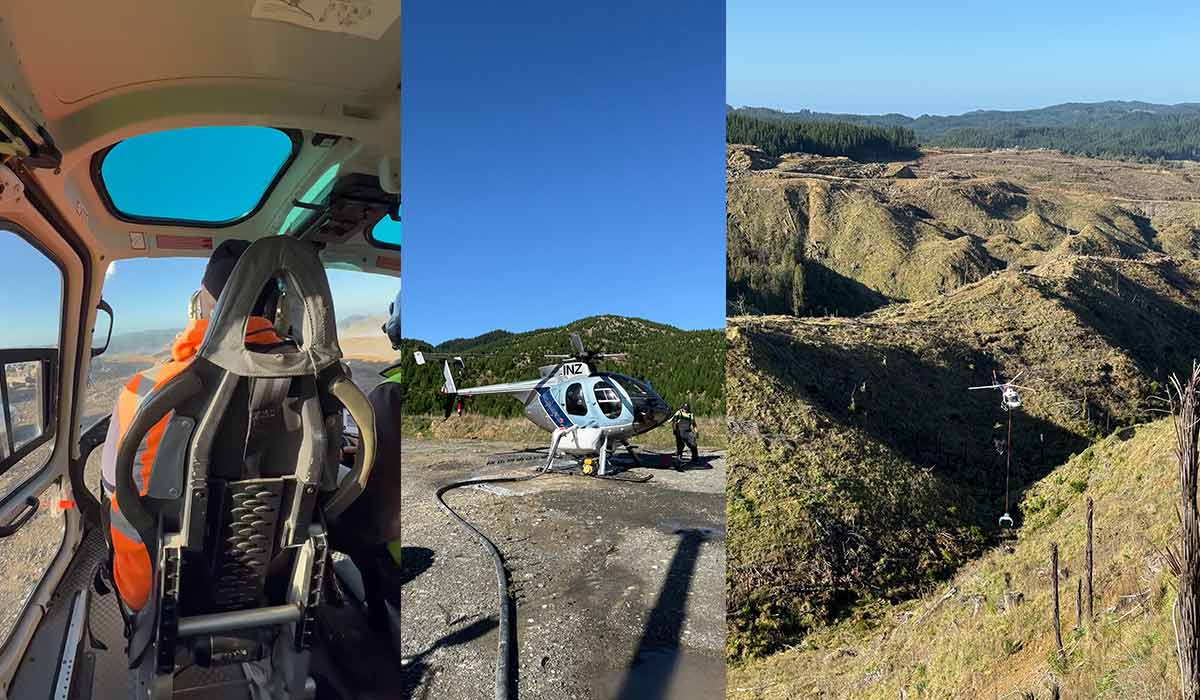
This desiccation is extremely harsh, involving huge areas of land, and killing everything in its path. To me, the demands of production seem to outweigh the protection of the environment. Although there are strict rules surrounding quantities of chemicals, buffer zones, spraying weather, and stakeholder engagement, I believe there could still be more focus on a reduction in the use of chemicals.
A huge benefit and boost to my learning and understanding of New Zealand forestry has been living with other foresters of the same age and at similar stages in our careers. Cameron, who has just started at Forest Management New Zealand (previously of Forest Enterprises) gave some interesting insights into a company that operates similarly to Tilhill with similar investors, scale, and operations (greenfield new planting, reports, timesheets etc.). Max and Liam who work for Forest Enterprises Limited (FEL) also gave me an opportunity to see how investment forestry is run in such close proximity to JNL’s forests. One evening I was invited over for Friday beers at the FEL office. On another occasion, FEL hosted a NZIF midweek webinar where we had pizzas and a pint in the office to encourage extra-curricular learning. More networking was done at the Southern North Island Wood Council Awards, which was an excellent place to network further with managers and contractors alike.
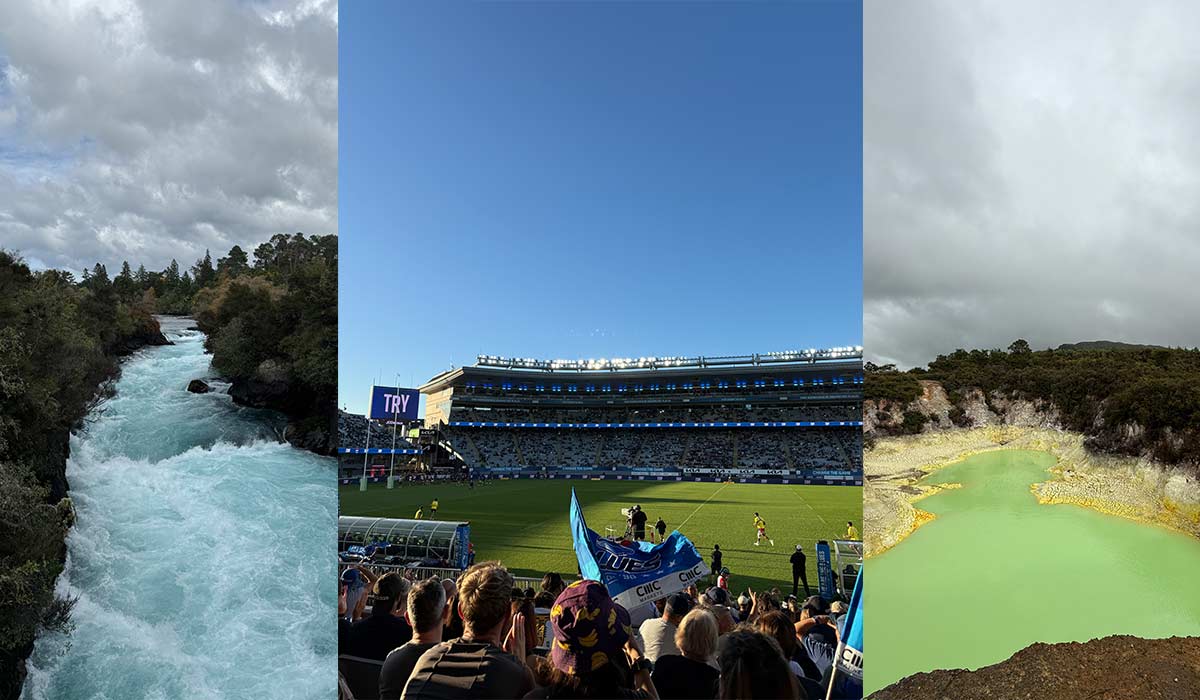
I had some weekend trips while visiting the north of North Island, including a weekend in Auckland watching the Blues vs Moana Pasifika and I spent the long Easter weekend in Rotorua and Taupo. I have weekends planned in Queenstown and Taranaki next, which should allow me to make the most of the remainder of my time in Aotearoa.